Dallas Weather Observation Field
About the Dallas Weather Observation Field
The Dallas Weather Observation Field (station KDWO) is a small network of personal weather stations in Texas: KDWO Dallas at the KDWO office and KDWO Lake Travis. They measure the weather every minute and share it live on this website and the KDWO phone line. KDWO also runs its own forecast office and sends local weather alerts for the Dallas area.
Our mission
What "KDWO" means
Weather stations are known by short call signs. Airports in the U.S. start with K (Love Field is KDAL), so the station follows the same style: K + Dallas Weather Observation. KDWO is not an airport or government station. It's an independent, personally run weather station network.
Have a question? See Questions & Answers.
The KDWO Station Networkall stations »
KDWO started as one weather station at the KDWO office in Dallas. It's growing into a small network, and every station gets its own page, graphs, gauges, records and climate reports. KDWO is the name of the whole network.
KDWO Dallas is the hub, KDWO Lake Travis is secondary coverage. KDWO Dallas is the main KDWO station and runs every KDWO service. KDWO Lake Travis extends KDWO's coverage to Central Texas: it has its own weather page, lake data, graphs, gauges, records and climate reports, while the forecast office, alerts, phone line and radio stay with the hub. Central Texas forecasts and warnings come from the NWS Austin/San Antonio office.
Why a station at Lake Travis?
- The lake makes its own weather. The closest official station is an airport on land. Wind over open water is usually stronger and gustier, and storms can hit the lake differently. KDWO Lake Travis measures what it's really like on the water.
- Lake data in one place. The Lake Travis level, percent full and lake temperature from public water data (USGS, LCRA, the Texas Water Development Board and the ARL:UT Lake Travis Test Station), right next to the weather.
- For people on the lake. Boaters, swimmers, anglers and lake residents can check real wind, gusts, rain and water temperature before heading out.
- More data for everyone. Once online, KDWO Lake Travis shares its readings with CWOP and NOAA MADIS like KDWO Dallas does, adding a station where data is thin, and builds its own records and climate history for Lake Travis.
Your nearest station
kdwo.org opens to the KDWO station closest to you, so people around Austin and the Hill Country land on Lake Travis. Switch any time from the Stations menu, or save a home station on the stations page. Its weather comes from KDWO's AcuRite station at the lake (through Weather Underground), and the lake level and temperature come from public water data.
What KDWO Does
An Independent Weather Office
KDWO is modeled after a traditional weather forecast office, but it isn't a copy of one. It runs on its own station, its own forecasts and its own alerts, and adds free public National Weather Service data on top.
Built by KDWO
- Live readings from the KDWO station's own sensors
- The KDWO forecast and KDWO-MOS, which learn from this station and correct the computer models
- KDWO alerts, issued by KDWO and sent by call and text to subscribers
- The DFW Mesonet: 100+ stations combined and quality-checked
- The KDWO Webcam, timelapses, phone line and Android app
- Lightning alerts, live gauges, neighborhood-level data and the KDWO alert map
Public data KDWO uses
- NWS radar
- NWS forecasts, warnings and products
- Storm Prediction Center outlooks
- Airport weather observations
This is free public data that weather websites and apps everywhere rely on.
KDWO is an independent, personally run weather office. It is not part of or affiliated with the National Weather Service. Always follow official NWS warnings.
How the Data Flows
- Sensors measure. At KDWO Dallas the outdoor sensors send readings by radio to an Ecowitt gateway inside. At KDWO Lake Travis an AcuRite 5-in-1 sends readings by radio to an AcuRite display hub, which uploads them to Weather Underground.
- KDWO Lake Travis reports in. The KDWO station computer pulls the latest Lake Travis reading from Weather Underground every couple of minutes.
- The station computer records. WeeWX saves every reading to the KDWO database and checks it for problems.
- Everything updates. The website, graphs, phone line and app pull from the same live data, so they always match.
- The data is shared. Every 10 minutes KDWO uploads its observations to the Citizen Weather Observer Program (CWOP), which feeds NOAA's MADIS system.
Update schedule
| What | How often |
|---|---|
| Live conditions | every minute |
| Webcam image | about every 30 seconds |
| Database record + graphs | every 5 minutes |
| Upload to CWOP / NOAA MADIS | every 10 minutes |
| KDWO forecast | every 3 hours (sooner if the forecaster updates it) |
| Sky timelapse video | every evening after sunset |
| Station self-check | every minute (station status) |
The Sensors · KDWO Dallas
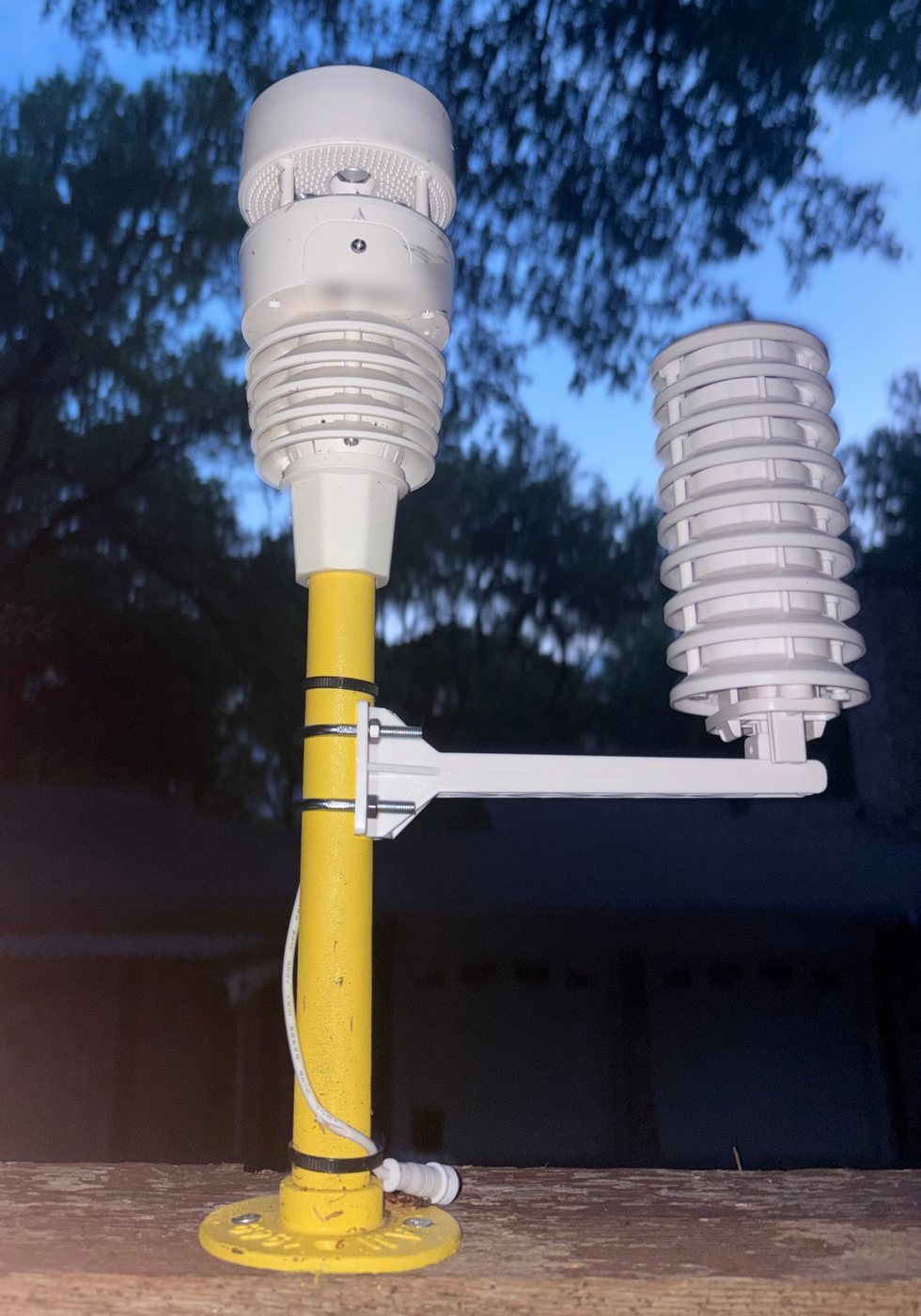
KDWO's outdoor sensors sit on a mounting pole outside the KDWO office, in open air, away from walls and pavement that hold heat, so the readings match the real air around the station.
- Main sensor array (top of the pole)
- Measures wind speed, gusts and direction with ultrasonic sound pulses, so there are no spinning cups to wear out or freeze. The top surface senses rain by the vibration of each drop, and a light sensor reads sunlight and UV.
- Radiation shield (on the side arm)
- The stack of white plates keeps the temperature and humidity sensor in the shade while letting air flow through. Without it, the sun would heat the sensor and readings would run too warm.
- Lightning detector
- An Ecowitt WH57 picks up the radio burst from lightning strikes and estimates how far away they are, out to about 25 miles.
- Webcam
- An Ecowitt Wittcam HP10 watches the sky over the KDWO office all day. Its images make the live webcam and the daily sunrise-to-sunset timelapse.
- Station computer
- Everything feeds a station computer running WeeWX, which saves every reading, builds the records and climate reports, and updates the site every minute.
How KDWO Warnings Work
- The station watches the weather. KDWO's sensors, the lightning detector, radar and National Weather Service warnings are checked around the clock.
- An alert is issued. Some alerts are sent by the station operator when a storm is coming. Others fire automatically when the station measures something dangerous (see the table below).
- It goes out everywhere at once. The alert shows up on every KDWO channel within seconds.
- An all clear ends it. When the danger passes, KDWO sends an all clear so you know it's over.
Automatic alerts from the station
| When KDWO measures… | It sends |
|---|---|
| Temperature below 32°F | Winter weather alert |
| Heat index above 105°F | Extreme heat alert |
| Wind gust above 50 mph | High wind alert |
| Rain falling faster than 2 in/hour | Street flooding alert |
| Lightning within 10 miles | Lightning alert (the operator approves it first) |
Each automatic alert sends once per event and won't repeat until conditions ease, so you aren't flooded with notifications.
Where alerts reach you
Colors
Alerts use the same colors as the National Weather Service map, so red always means tornado, orange means severe thunderstorm, and so on.
KDWO alerts are unofficial. They add local detail but never replace the National Weather Service. Always follow official warnings, and call 911 in an emergency.
Accuracy & Limits
KDWO's sensors are good consumer-grade instruments, sited in open air and shaded from the sun. Readings are checked against nearby stations like Love Field (KDAL) and the CWOP data quality report.
- Your street may differ. Dallas weather changes block to block. Storms can drop rain on one neighborhood and miss the next, and pavement makes some areas run warmer.
- Rain in strong wind. Any rain gauge can read a little low in heavy wind-driven rain.
- Lightning distance is an estimate. The detector is good at telling near from far, but the miles are approximate.
- Outages happen. Power or internet loss can pause the station. Gaps show up on the status page and in the graphs.
Station Timeline
| When | Milestone |
|---|---|
| December 2025 | Registered with CWOP as GW6844, sharing data with NOAA MADIS |
| October 2026 | KDWO Forecast Office, interactive radar, graphs and station status page |
| November 2026 | KDWO Station Network: the KDWO Lake Travis page and the Stations menu |
| November 2026 | KDWO Station Network: the KDWO Lake Travis page and the Stations menu |
More Station Photos
KDWO Dallas
| Network | KDWO |
| Role | Main KDWO hub (all KDWO services) |
| Type | Personal weather station |
| Location | Dallas, Texas |
| CWOP ID | GW6844 |
| Days of data | -- |
| Operated by | @bruce_stormchaser |
| Sensor array | Ecowitt outdoor sensors |
| Lightning | Ecowitt WH57 |
| Webcam | Ecowitt Wittcam HP10 |
| Gateway | Ecowitt Wi-Fi gateway |
| Software | WeeWX |
The map pin on this site is placed near the station, not at its exact spot, for privacy.
KDWO Lake Travis
| Network | KDWO |
| Role | Secondary coverage area (reports to KDWO Dallas) |
| Location | Lake Travis, Texas |
| Status | checking… |
| Sensor array | AcuRite 5-in-1 |
| Receiver | AcuRite display hub |
| Uploads to | Weather Underground (KTXDALLA1421) |
| Pressure | AcuRite display hub (indoor sensor) |
| Lake data | Public water data (USGS, LCRA, TWDB, ARL:UT) |
| Software | KDWO hub (pulls from Weather Underground) |
Get KDWO Alerts
Data Sharing
GW6844 on findU (CWOP) »
CWOP data quality report »